Standard Deviation (STDEV)
Function Syntax
=STDEV_INDICATOR(data, period) data(array):
Range of columns containing the date, Open, high, Low, close, volume data.period(number):
Number of (periods) days over which to calculate the Standard Deviation.
Returns:
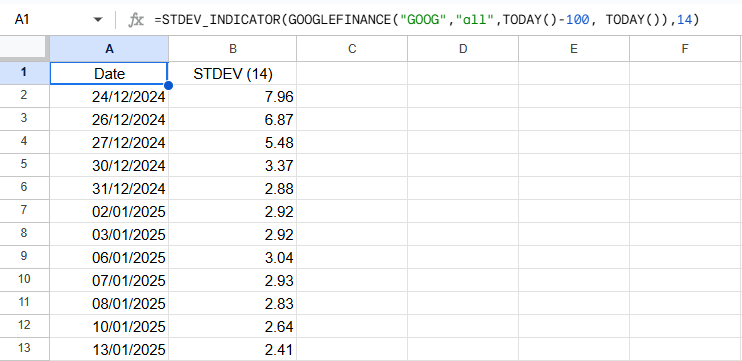
A two-column array of dates and their corresponding Standard Deviation values.
Google Sheets Output Example
Below is an example of the resulting array when applying the custom STDEV_INDICATOR() function in Google Sheets
Apps Scripts Code
Here’s the full Google Apps Script code.
Paste this directly into the Google Sheets Apps Script editor (Extensions → Apps Script):
stdev_indicator.gs
/**

 * Calculates the Standard Deviation for raw price data using the SMA function.

 *

 * @param {array} data - an array where the first column is the  dates, and subsequent columns for  open, high, low, close and volume.

 * @param {number} period The period for calculating the Standard Deviation.

 * @returns {array} - an array with dates corresponding and the stdev values

 * @customfunction

 */

function STDEV_INDICATOR(data, period) {


  //Check number of arguments

  if (arguments.length !== STDEV_INDICATOR.length) {

    throw new Error(`Wrong number of arguments. Expected ${STDEV_INDICATOR.length} arguments, but got ${arguments.length} arguments.`);

  }


  // Preprocess data using getData

  const processedData = getData(data);

  const dates = processedData.slice(1).map(row => row[0]); // Extract dates

  const closePrices = processedData[0].length === 2

    ? processedData.slice(1).map(row => row[1]) // For 2-column arrays, use the second column

    : processedData.slice(1).map(row => row[4]); // Default: use index 4 for close price

  // Check if the period is greater than the length of the data

  if (period > closePrices.length) {

    throw new Error("Error: The specified period exceeds the length of the data.");

  }


  // Calculate the SMA for the given period

  const smaValues = SMA(data, period).slice(1); // Remove headers, format: [Date, SMA]


  // Initialize an array to hold standard deviation values

  const stdevValues = [["Date", `STDEV (${period})`]];


  // Calculate moving standard deviation for each data point

  for (let i = period - 1; i < closePrices.length; i++) {

    const mean = smaValues[i - (period - 1)][1]; // Use SMA value as the mean

    const periodPrices = closePrices.slice(i - period + 1, i + 1); // Get the prices for the period


    // Calculate the squared differences

    const squaredDifferences = periodPrices.map(val => Math.pow(val - mean, 2));


    // Calculate the variance

    const variance = squaredDifferences.reduce((acc, val) => acc + val, 0) / period;


    // Calculate the standard deviation

    const standardDeviation = Math.sqrt(variance);


    // Append the results with the corresponding date

    stdevValues.push([dates[i], standardDeviation]);

  }


  return stdevValues;

}


/**

 *

 * @param {Array<Array>} data - A 2D array of cell values to process. The first row should contain headers.

 * @returns {Array<Array>} - A 2D array where the first row contains headers and subsequent rows contain processed data.

 *

 * @customfunction

 *

 */


function getData(data) {

  if (!Array.isArray(data) || data.length === 0) {

    throw new Error("Input data must be a non-empty array.");

  }


  // Check if the first row contains headers

  const headers = Array.isArray(data[0]) && data[0].every(item => typeof item === "string")

    ? data[0]

    : null;


  if (!headers) {

    // If no headers, assume the first column is the date column and process data

    return data.map(row => row.map((value, index) => {

      return index === 0 ? new Date(value) : parseFloat(value);

    }));

  }


  // Process rows with headers

  return [headers, ...data.slice(1).map(row => headers.map((header, index) => {

    const key = header.toLowerCase();

    return key === "date" ? new Date(row[index]) : parseFloat(row[index]) || row[index];

  }))];

}


/**

 * Calculates the Simple Moving Average (SMA) for a given dataset and period.

 *

 * @param {array} data - an array where the first column is the  dates, and subsequent columns for  open, high, low, close and volume.

 * @param {number} period The number of periods to calculate the SMA, e.g., 14 for a 14-day SMA.

 * @returns {Array<Array>} The Simple Moving Average (SMA) of the range.

 * @customfunction

 */


function SMA(data, period) {


  //Check number of arguments

  if (arguments.length !== SMA.length) {

    throw new Error(`Wrong number of arguments. Expected ${SMA.length} arguments, but got ${arguments.length} arguments.`);

  }

  const processedData = getData(data);

  const dates = processedData.slice(1).map(row => row[0]); // Extract dates

  const closePrices = processedData[0].length === 2

    ? processedData.slice(1).map(row => row[1]) // For 2-column arrays, use the second column

    : processedData.slice(1).map(row => row[4]); // Default: use index 4 for close price


  // Check if the period is greater than the length of the data

  if (period > closePrices.length) {

    throw new Error("Error: The specified period exceeds the length of the data.");

  }


  // Initialize an array to store SMA values with corresponding dates

  let results = [["Date", `SMA(${period})`]]; // Include headers


  // Calculate SMA for the given period

  for (let i = period - 1; i < closePrices.length; i++) {

    const periodPrices = closePrices.slice(i - period + 1, i + 1); // Get the slice for the period

    const sma = periodPrices.reduce((acc, val) => acc + val, 0) / period; // Calculate average


    // Append the current date and SMA to the results array

    results.push([dates[i], sma]);

  }


  return results;

}
Last updated on