Moving Average Convergence Divergence (MACD)
Function Syntax
=MACD(data,shortPeriod, longPeriod,signalPeriod ) -
data(array) :
Range of columns containing the date, Open, high, Low, close, volume data. -
shortPeriod(number):
Number of periods (days) used for calculating the short-term Exponential Moving Average (EMA). Typically 12 periods. -
longPeriod(number):
Number of periods (days) used for calculating the long-term EMA. Typically 26 periods. -
signalPeriod(number):
Number of periods (days) used for calculating the EMA of the MACD line itself, known as the signal line. Typically 9 periods.
Returns:
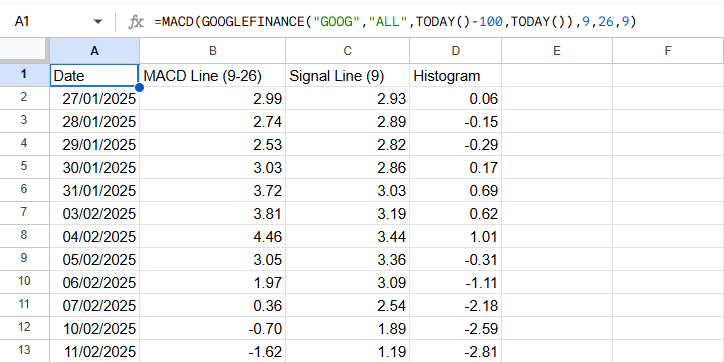
A four-column array of dates with corresponding MACD line, signal line, and histogram values.
Google Sheets Output Example
Below is an example of the resulting array when applying the custom MACD() function in Google Sheets
Apps Scripts Code
Here’s the full Google Apps Script code.
Paste this directly into the Google Sheets Apps Script editor (Extensions → Apps Script):
/**

 * Calculates the Moving Average Convergence Divergence (MACD) for a given dataset and periods.

 *

 * @param {array} data - an array where the first column is the  dates, and subsequent columns for  open, high, low, close and volume.

 * @param {number} shortPeriod The number of periods for the short EMA, e.g., 12 for a 12-day EMA.

 * @param {number} longPeriod The number of periods for the long EMA. e.g., 26 for a 26-day EMA.

 * @param {number} signalPeriod The number of periods for the signal line EMA. e.g., 9 for a 9-day EMA.

 * @returns {Array} The MACD values along with corresponding dates.

 * @customfunction

 */


function MACD(data, shortPeriod, longPeriod, signalPeriod) {


  //Check number of arguments

  if (arguments.length !== MACD.length) {

    throw new Error(`Wrong number of arguments. Expected ${MACD.length} arguments, but got ${arguments.length} arguments.`);

  }


  const processedData = getData(data);

  const dates = processedData.slice(1).map(row => row[0]); // Extract dates


  // Calculate short and long EMAs from the processed data

  const shortEMA = EMA(data, shortPeriod).slice(1); // Remove headers

  const longEMA = EMA(data, longPeriod).slice(1); // Remove headers


  // Align the lengths of short and long EMAs

  const [alignedShortEMA, alignedLongEMA] = alignLENGTHS(shortEMA, longEMA);


  // Calculate the MACD line

  const macdLine = alignedShortEMA.map((row, i) => {

    const date = row[0];

    const value = row[1] - alignedLongEMA[i][1];

    return [date, value];

  });


  // Calculate the signal line from the MACD line

  const signalLine = EMA(macdLine.map(item => [item[0], item[1]]), signalPeriod).slice(1); // Remove headers


  // Align the lengths of the MACD line and signal line

  const [alignedMacdLine, alignedSignalLine] = alignLENGTHS(macdLine, signalLine);


  // Calculate the histogram

  const histogram = alignedMacdLine.map((item, i) => {

    return [item[0], item[1], alignedSignalLine[i][1], item[1] - alignedSignalLine[i][1]];

  });


  // Prepare the final MACD data structure

  return [["Date", `MACD Line (${shortPeriod}-${longPeriod})`, `Signal Line (${signalPeriod})`, "Histogram"], ...histogram];


}


/**

 *

 * @param {Array<Array>} data - A 2D array of cell values to process. The first row should contain headers.

 * @returns {Array<Array>} - A 2D array where the first row contains headers and subsequent rows contain processed data.

 *

 * @customfunction

 *

 */


function getData(data) {

  if (!Array.isArray(data) || data.length === 0) {

    throw new Error("Input data must be a non-empty array.");

  }


  // Check if the first row contains headers

  const headers = Array.isArray(data[0]) && data[0].every(item => typeof item === "string")

    ? data[0]

    : null;


  if (!headers) {

    // If no headers, assume the first column is the date column and process data

    return data.map(row => row.map((value, index) => {

      return index === 0 ? new Date(value) : parseFloat(value);

    }));

  }


  // Process rows with headers

  return [headers, ...data.slice(1).map(row => headers.map((header, index) => {

    const key = header.toLowerCase();

    return key === "date" ? new Date(row[index]) : parseFloat(row[index]) || row[index];

  }))];

}


/**

 * Calculates the Exponential Moving Average (EMA) for a given dataset and period

 *

 * @param {array} data - an array where the first column is the  dates, and subsequent columns for  open, high, low, close and volume.

 * @param {number} period The number of periods to calculate the EMA, e.g., 14 for a 14-day EMA.

 * @returns {array} the EMA values along with corresponding dates.

 * @customfunction

 */


function EMA(data, period) {


  //Check number of arguments

  if (arguments.length !== EMA.length) {

    throw new Error(`Wrong number of arguments. Expected ${EMA.length} arguments, but got ${arguments.length} arguments.`);

  }


  const processedData = getData(data);

  const dates = processedData.slice(1).map(row => row[0]); // Extract dates

  const closePrices = processedData[0].length === 2

    ? processedData.slice(1).map(row => row[1]) // For 2-column arrays, use the second column

    : processedData.slice(1).map(row => row[4]); // Default: use index 4 for close price


  // Initialize an array to store EMA values with corresponding dates

  let results = [["Date", `EMA(${period})`]]; // Include headers


  // Calculate the multiplier for EMA calculation

  const multiplier = 2 / (period + 1);


  // Calculate SMA for the first n data points

  let sum = 0;

  for (let i = 0; i < period; i++) {

    sum += closePrices[i];

  }

  let sma = sum / period;


  // The first EMA will have the date corresponding to the nth entry (0-indexed, hence n-1)

  results.push([dates[period - 1], sma]);


  // Calculate EMA for the remaining data points

  for (let i = period; i < closePrices.length; i++) {

    const currentClose = closePrices[i];

    const prevEMA = results[results.length - 1][1];

    const currentEMA = (currentClose - prevEMA) * multiplier + prevEMA;


    // Append the current date and EMA to the results array

    results.push([dates[i], currentEMA]);

  }


  return results;

}


/**

 * Aligns the lengths of two arrays by trimming the longer array to match the shorter one.

 *

 * @param {Array} arr1 - The first array.

 * @param {Array} arr2 - The second array.

 * @returns {Array} - An array containing two aligned arrays.

 */


function alignLENGTHS(arr1, arr2) {

  const lengthDiff = arr1.length - arr2.length;

  if (lengthDiff > 0) {

    return [arr1.slice(lengthDiff), arr2];

  } else if (lengthDiff < 0) {

    return [arr1, arr2.slice(-lengthDiff)];

  }

  return [arr1, arr2];

}